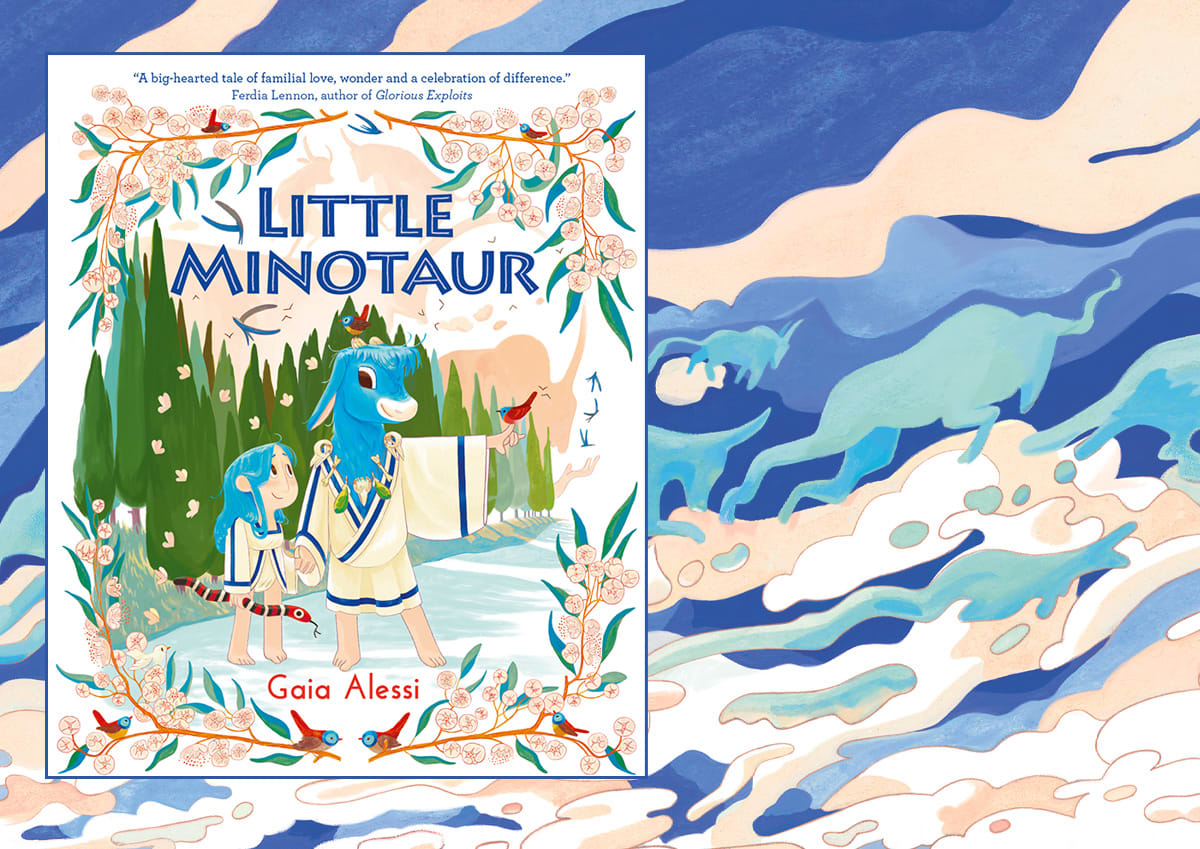
Every so often a picture book comes along that takes a story you think you know and turns it completely on its head. Little Minotaur, Gaia Alessi's debut with Walker Books, does exactly that - reimagining Asterion not as a monster to be slain, but as a bull-headed boy growing up in a family who loves him.
It's a re-telling rooted in a childhood spent among Etruscan ruins and Greek antiquities, and in one image in particular - a small clay cup, glimpsed years ago, showing the infant Minotaur held tenderly on his mother's lap. That single picture has clearly stayed with Gaia, and it's the quiet, curious heart beating underneath this whole book.
Ahead of the book's publication on 10th September, we sat down with Gaia to talk about swapping Theseus for Asterion, designing a protagonist somewhere between boy and Desi cattle, and why messages are most definitely not her jam.
Introducing Little Minotaur: Gaia Alessi in conversation
Myths and legends have experienced an incredible resurgence in popularity in recent years, so creating Little Minotaur couldn’t have come at a better time. Did you study the original Greek myth and which elements from the original story did you transfer to your re-telling?
My parents were single-mindedly passionate about Greco-Roman antiquities. Greco-Roman books carved a hefty space into our bookshelves, my sisters and I have names derived from classical antiquity and at bedtime we were told or read stories from The Odyssey, The Iliad or the Greek mythological canon.
Our holidays were spent moving up and down the length of Italy from one archeological site or museum to the next. My father was particularly obsessed with the Etruscan people so we visited all the archeological sites at Tarquinia, Cerveteri and Vulci over and over. As you can imagine, it was extremely dull for a child to weave in and out of badly lit rooms, and pour over insane amounts of old crockery in glass cabinets. But I was always glad to see the two towering winged horses who must have lived at the top of a temple at some point in the past. If only my parents could have left me at their feet for the duration of their visit, with a bag of crisps and a cold drink, that would have been bliss!
And then there was this particular plate. It looked like a small double-handled frying pan, perfect for two eggs. On the plate (which I later learned is a cup called a kylix, a chalice), Asterion is painted as a happy toddler sitting on his mother’s lap. Since then that image has insistently surfaced in my memory: how could tenderness like this be possible towards such a creature? For the Etruscans it was.
And because of that the story of the Minotaur has always made me angry. In it the hero, Theseus, rids the world of a people who blatantly offend Poseidon (would the Cretans even worship Greek gods?), interbreed with cattle, whose offsprings are monstrous creatures that eat human flesh and in which sisters betray brothers and in turn are betrayed by their beloved. Good grief! Is it propaganda? Or slander? Possibly to justify a war of conquest, so that all that is left for posterity to know about the Cretans is that they where abhorrent, especially Queen Pasiphaë and her children.
So when I finally decided I could put pen to paper, I told myself, out with the traditional hero and in with a different portrayal of Crete, of family love, personal choice and heroic deeds.
Gaia is also the name of a Greek goddess who was believed to have given birth to the Ocean, the sky, the mountains and the first mortals. Did having a name inspired by Greek mythology trigger your interest in myths and legends and do you have a favourite God and Goddess?
Oh yes, Gaia…the only thing we truly share is that we both emerge from Chaos…you should share a coffee with me first thing in the morning! To be perfectly honest as a child I hated my name, I was routinely teased, by everyone, up until high school. Not fun.
I’m not a believer of gods and otherworldly powers, but I love flights of fantasy, always have. My favourite question is “what if?”. So to go along with your “what if ancient Greek gods were real?”, it is a toss between Athena and Artemis, mostly because, as a child, I coveted their animals. I never could make my mind up if I’d rather have a flying doe (and race Father Christmas for presents) or settle for an owl (that would be easier to fit inside my bedroom and hide from my parents longterm). Also, Athena? Born out of her father’s headache? Respect.
You have an incredible talent for character creation. Re-imagining Asterion the Little Minotaur for a picture book audience must have had some challenges, how did you go about designing and finalising the look of the main protagonist?
I have piles of sketches of Asterion at various ages, with different bovine heads, with different shape and size horns. There are so many breeds of cows in the world! I filled three sketchbooks and reams and reams of paper going down various rabbit holes. He also changed colour various times, becoming pistachio green on occasion, but then I settled on a light blue because I wanted him to feel uncanny while still be likeable. No cattle has fur in any shade of blue and this way he would be more similar to his feathery friends.
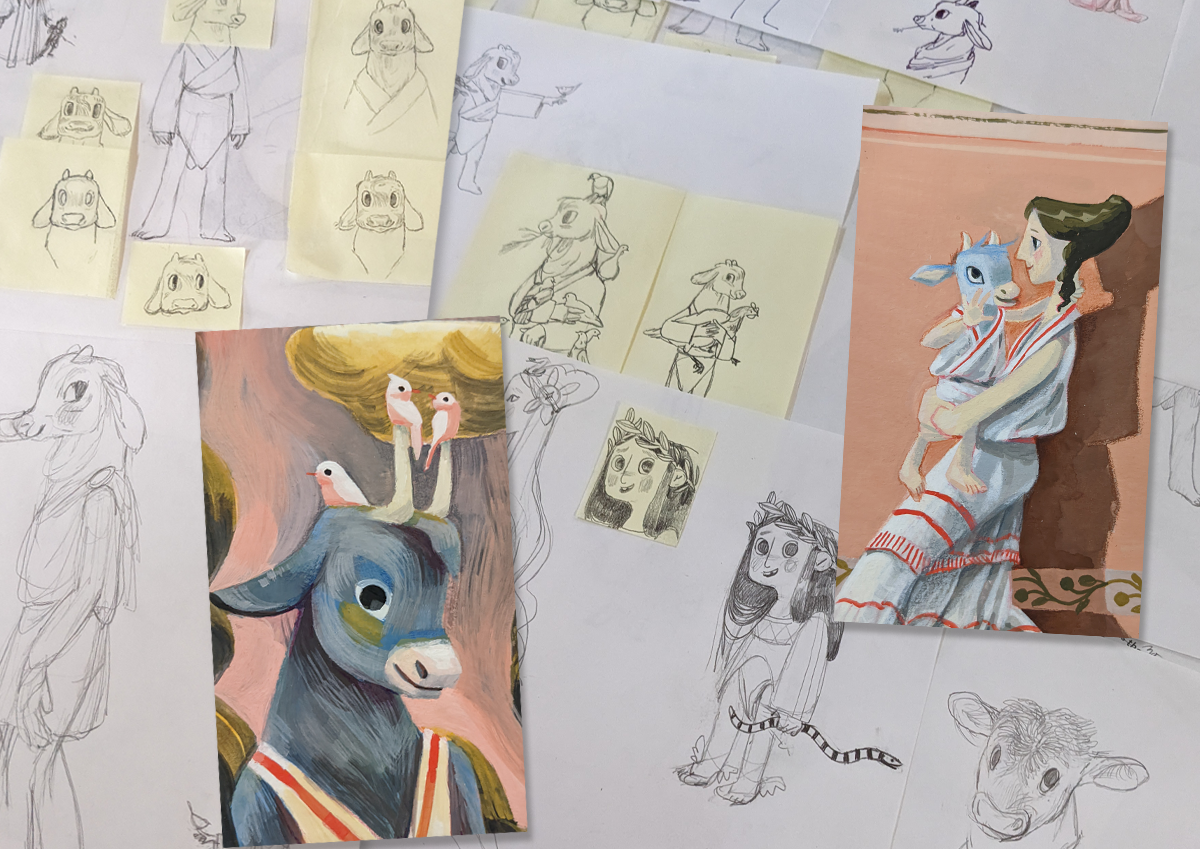
For his head I took inspiration mostly from Desi cattle, with their elongated head with a ridge in the middle, a bulging forehead, large glistening eyes and soft long ears. Their horns also mostly point backwards like Asterion’s. You can spot Desi cows silhouettes in the cloud shapes throughout the book. And there is also a wildebeest! I spent time sketching the wardrobe for the whole family, another rabbit hole. In the end I shelved most of the costumes as I decided simplicity would make the characters stand out.
With that in mind, when asked, Asterion chose to have a simple light coloured garment covering most of his chest and arms. The delicate area where his human skin meets his bull skin is extremely sensitive to light and prone to eczema and he doesn’t like people to see it. But he likes wearing necklaces. And making them. He made one for his sister but Ariadne keeps it hanging over her bed, a bit like a dreamcatcher. She doesn’t wear it because it’s too jangly and when she’s running fast it gets all tangled up in her hair.
How did you settle on the subtle colour scheme? Was it inspired by Greek ceramics / architecture?
It was inspired mostly by what remains of the frescoes of the Palace of Knossos in Crete, but the palette also had the hard task of making Asterion stand out. My very first palette had a lot of blacks and dark neutrals, it was very stormy and broody and heavily referenced the Attic red figure pottery. Once I started working with the team at Walker Books and the story changed to become more lighthearted and child-friendly we felt that the palette should reflect that. I have to lift a kylix overflowing with gratitude to Beth Aves for being so patient and supportive throughout the process of nailing down this delicate colour scheme. Thank you Beth.
Which is your favourite spread from the book and why?
Picking favourites? Not my talent! I like them all; each for a different reason and they all bring back different memories and emotions. When you make a picture book, a huge amount of time is spent working over an insane amount of drawings and paintings. And so I think we all make sure we paint things that fill our heart with joy with every single brushstroke or else we wouldn’t be able to sustain the process.
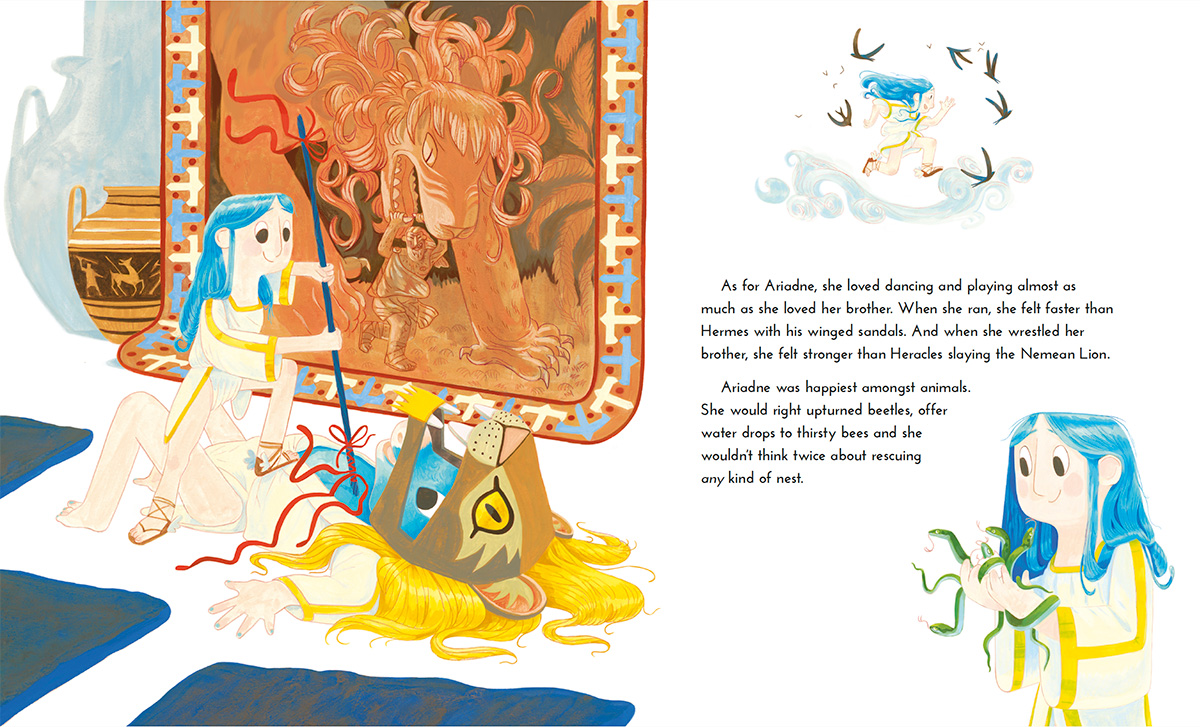
I like the spread with the tapestry of Heracles and the Nemean lion because Asterion feels the need to wear a mask in order to disguise himself as a blood thirsty monster, while his sister needs no artifice to play a hero.
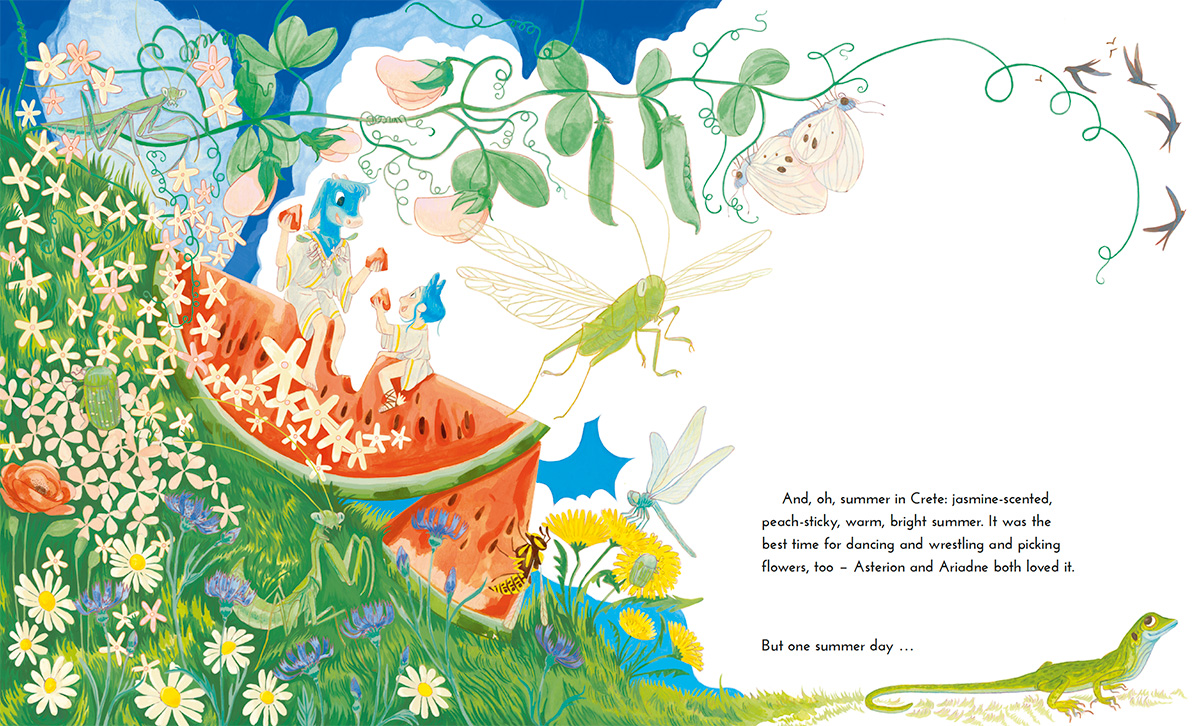
I like the summer spread because I miss the mantids, because I can smell the jasmine and, because who doesn’t want to sit on a gigantic slice of watermelon?
But most of all I think I like the spread in which Asterion and Ariadne travel the whole world following the birds.
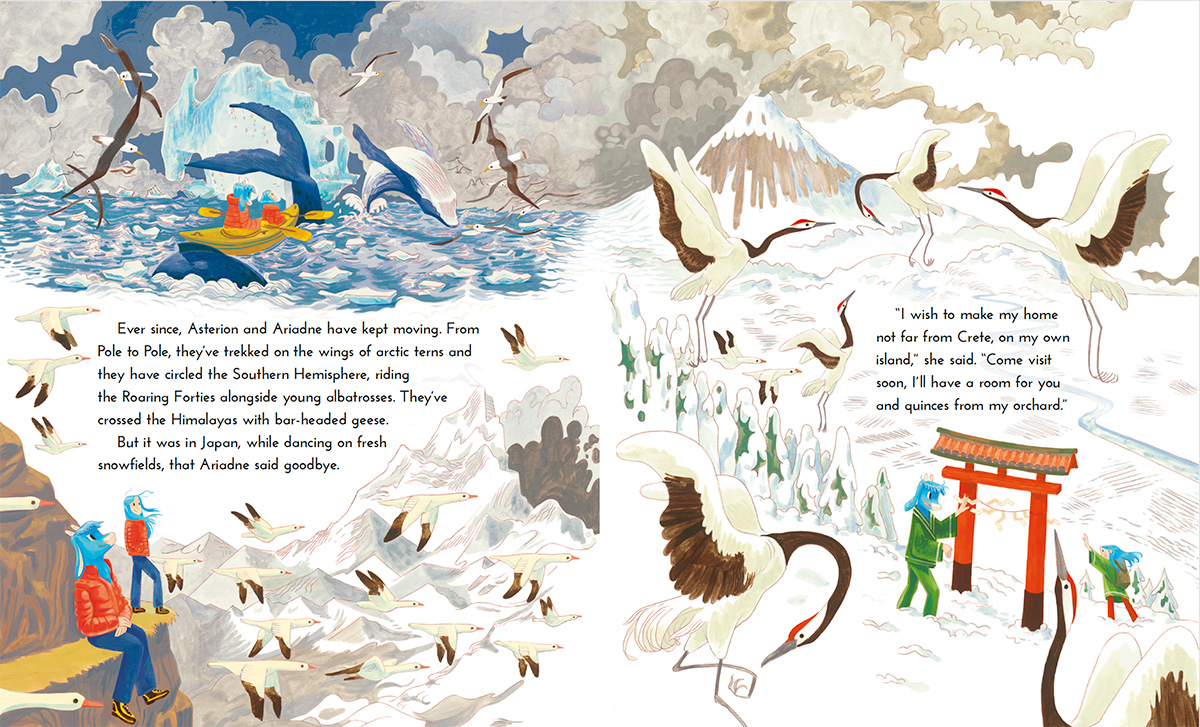
Finally the Minotaur is out of the labyrinth and a bull headed boy grows into a young man that has sailed the world’s oceans and climbed the Himalayas! I think if I had to pick just one that would be it, the one in which they are free and everything is possible ahead of them.
Are there any other Myths or legends you would like to re-imagine?
The Valkyries are completely enthralling. Odin’s chosen maids who haunted battlefields and handpicked those who were to die, all while riding terrific winged horses. And Gilgamesh. The other day I was walking Twig, my dog, with my daughter Cassi and she was telling me all about the epic of Gilgamesh and Enkidu, the wild man. Her retelling of the first few chapters was so enthralling that I am hooked!
I also have been reading about Genghis Khan and his daughters, the Mongol Queens, who are particularly captivating, Attila the Hun and the northern frontiers of the Roman Empire and have stacks of materials about the Nenet people of Siberia and their reindeers. Yes, I have a soft spot for nomadic people: nothing feels better to me than roaming through endless landscapes with a herd of hoof-stock.
But right now, while talking to you and remembering all things past, I feel that perhaps telling the story of that child locked in a summer labyrinth of museum cabinets would be more honest, funny and relatable for children out there.
What are the key messages you hope that young readers will take away from sharing this story?
Oh gosh no! Messages are not my jam. Seriously I have no prophetic bones in my body.
I just thought, what if we got it wrong? What if the Minotaur just chewed grass? What I wish is for this story to take readers along a good journey, one in which they might come with me to places they haven’t been to and meet people they hadn’t thought about until they turned that page. But most of all I wanted to give the Minotaur a break. To offer him at least one small story in which the world is seen from his eyes.
Many thanks to Gaia for answering all our questions so beautifully.
Little Minotaur publishes with Walker Books on 10th September - you can pre-order your copy from your local bookshop, Waterstones and other online retailers or from your local library. You can find Gaia at Phlox Books in Leyton, on Sunday 13th September where she will be reading from Little Minotaur, drawing pictures and helping everyone to make their own Asterion head-mask. Book your free tickets online from Phlox Books.
See more amazing illustrations by Gaia Alessi over on her portfolio, including a selection of spreads from Little Minotaur. You can follow Gaia on Instagram and don't forget to sign up to the Arena e-newsletter to keep up to date with all of our Artists' latest projects.


